
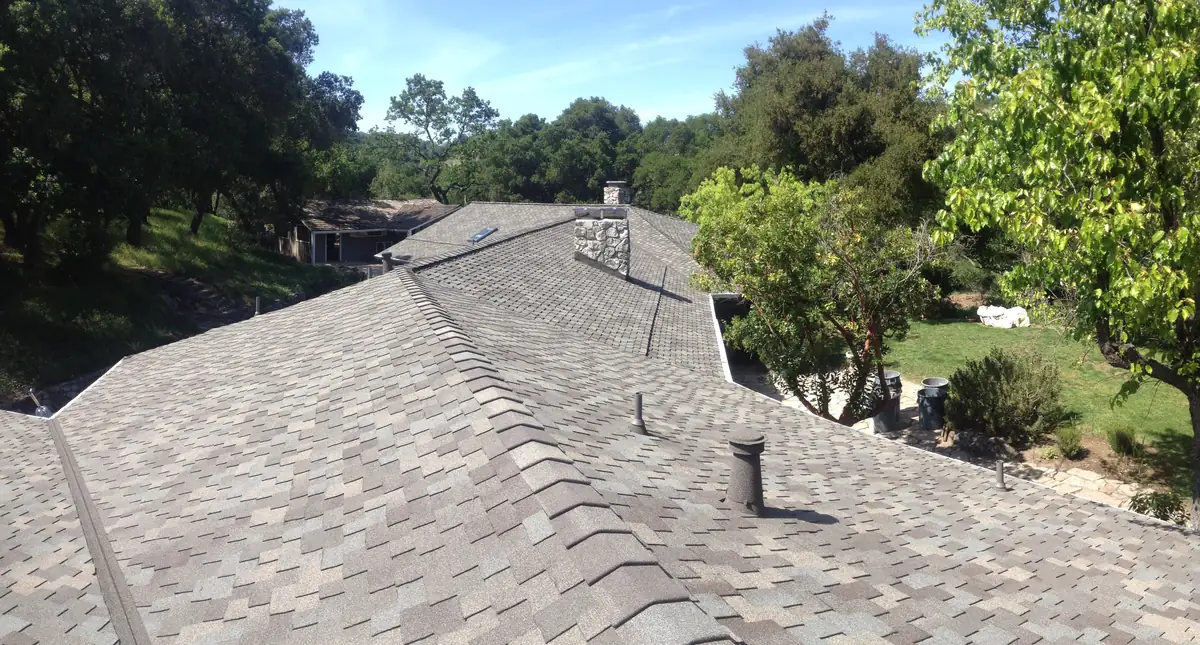
Roofing in Hayward, CA
Hayward is the next big city north of Fremont on I-880 and Mission Boulevard, past Union City, and Sonrise Roofing has been working its streets since 1986.
Hayward is the next big city north of Fremont on I-880 and Mission Boulevard, past Union City, and Sonrise Roofing has been working its streets since 1986. The city runs from the salt marshes of the Hayward Regional Shoreline up to the Cal State East Bay campus on the ridge, and a roof at the top of that climb lives a different life than a roof at the bottom. This page covers both, because we roof both.
Where the Hayward Fault Divides the Hayward Hills from the Flats
The single most important line in Hayward is not a street. The Hayward Fault runs along the base of the hills through the middle of the city, roughly parallel to Mission Boulevard, and the U.S. Geological Survey has called it one of the most dangerous faults in the country because so many people live on top of it. The earthquake of October 1868 leveled nearly every building in the town. Cal State East Bay's main campus sits on a plateau just east of the fault, and its old Warren Hall tower, which stood about 2,000 feet from the fault trace, was imploded in 2013 because it could not be made safe.
For a roofer, the fault is a reminder that Hayward homes get shaken, and that shaking loosens things on a roof: chimney flashings pull away from masonry, tile slips, old mortar at ridge caps cracks. Seismic retrofit work on the foundation gets a lot of attention here, and rightly so, but the roof is part of the same conversation. When we do a roof inspection in Hayward we pay particular attention to the chimney and to any tile or masonry detail that has been worked loose.
Hayward Hills Homes East of Mission Boulevard
Uphill from Mission Boulevard, in ZIP 94542 and the eastern edge of 94541, the neighborhoods around Cal State East Bay and the Hayward Highland area were mostly built in the 1960s on lots with views across the bay. These are larger homes than the flatland tracts, often two stories, with more complex roofs: hips and valleys, multiple dormers, and in many cases concrete tile that has outlasted the felt underneath it. Skylights are common on these houses, and a skylight curb that was flashed in the 1970s is a frequent source of the stain on a hillside ceiling. Because the hills catch wind and rain that the flats do not, the valleys and the windward eaves take a beating, and the north-facing slopes under the oaks grow moss that holds water against the shingle.
A hillside roof replacement in Hayward means more care with staging and access, more attention to the valley metal and the underlayment, and usually a conversation about ventilation, since a 1960s two-story on a hill traps heat in the attic on a summer afternoon. We also get plenty of leak calls from the hills that turn out to be one failed pipe flashing on a roof that is otherwise sound, and we treat those as the small jobs they are.
Hayward Flatland Tracts: Southgate, Fairway Park and the Streets Near B Street
Downhill, Hayward is a city of postwar tracts. The land west of Mission Boulevard was ranches and orchards until the 1950s, when the housing came in fast. Southgate, on the flats west of I-880 in 94545, is a neighborhood of single-story homes from the 1960s with a community pool that has been there since about 1960. Fairway Park, in south Hayward in ZIP 94544, is a mix of homes built between the 1960s and the 1980s, many of them remodeled inside but still carrying a tired roof. Both neighborhoods are full of low-pitched composition shingle roofs with three or four plumbing vents, an original attic that has never been properly ventilated, and gutters that were sized for a climate with less debris than the one Hayward's street trees have created.
Closer to downtown, the older streets off B Street and around the Hayward BART station in 94541 hold houses from the 1920s through the 1940s, small bungalows and cottages with steeper pitches, brick chimneys and, in some cases, a roof deck of spaced boards meant for wood shingles. On those homes our roof repair work often includes replacing rotted soffit and fascia at the eaves and rebuilding the chimney flashing, which on a house that age has usually been patched with roofing cement more than once.
Fog, Moss and the Bayside Weather on Hayward Roofs
Hayward sits in California Energy Code climate zone 3, the same coastal zone as Fremont, and its weather is milder than the inland Tri-Valley. July highs average in the mid 70s, and the summer marine layer pushes in from the bay most mornings, especially over the western flats near the shoreline. Annual rainfall is a little higher than Fremont's, around 18 inches, and it arrives between November and March, often in the concentrated bursts of an atmospheric-river storm.
That morning fog is the reason Hayward roofs on the bay side grow moss and algae so readily. A north-facing slope in Southgate that never dries out until noon is the perfect place for moss to take hold, and moss lifts shingle edges and holds water where it should run off. Our roof maintenance work in Hayward is mostly moss removal, roof cleaning and gutter clearing timed before the first November storm. The wet air also does something quieter: it corrodes painted metal. Which brings us to the flashings.
Why Stone-Coated Flashings Suit Hayward's Damp Bayside Roofs
The vents and pipe flashings on almost every Hayward roof were painted at installation, and paint on galvanized metal that sits in fog every morning does not last. It can begin to wear within the first year, and once the metal is exposed it rusts, the rust stains the shingle, and the seal at the base of the pipe, which is the most common leak point on any roof, starts to fail.
Sonrise Roofing finishes Hayward roofs with stone-coated flashings from California Stone Coating, the Fremont manufacturer. The stone coating is a long-lasting finish that matches the shingle color, resists rust, and is designed not to chip, peel or fade. On the bay side of Hayward, where the air is wet more often than it is dry, that resistance to rust is the difference between a flashing that looks and works the same in year ten as it did on day one and one that has to be re-caulked every rainy season. The full process is on the stone-coated flashings page. They go on as part of a roof replacement, in Southgate or up in the hills, because the flashing plates are laid in under the shingle courses.
Gutters, Permits and Getting a Hayward Roof Done Right
Hayward's street trees and hillside oaks fill gutters fast, and an overflowing gutter is the leading cause of the rotted fascia we replace on the older homes near downtown. Our gutters and downspouts work in Hayward includes new seamless gutters, gutter guards for houses under heavy tree cover, and cleaning before the rains. On the older bungalows near B Street we often find the downspouts discharging at the foundation, and we re-route them while we are there.
Hayward also has a large industrial belt along Industrial Parkway and west of I-880 toward the shoreline, with warehouses, shops and small office buildings on low-slope roofs. Our commercial roofing work there is mostly single-ply membrane and coating jobs on buildings where ponding water and clogged drains have started to find their way inside. The same crew that roofs a Southgate ranch house handles a Hayward warehouse, and the same stone-coated flashings go on the pipe penetrations.
Re-roofing in Hayward requires a building permit from the city's Building Division when more than 200 square feet of roof covering is installed or replaced. Like-for-like re-roof permits are issued over the counter or online through the Permit Center, and we take care of that as part of the job. Hayward is one stop on our service area map: Union City sits between Hayward and our Fremont office, San Leandro is the next city north, and Fremont is home.

Testimonials
Real feedback from the East Bay and South Bay homeowners who trusted Sonrise Roofing with their roofs.
Frequently Asked Questions
Yes, and it is not far. Our office is in Fremont's Centerville district, and Hayward is straight up Mission Boulevard or I-880 past Union City. We have worked in Hayward since 1986.
Yes. Tile roofs from the 1960s and 1970s usually have failed underlayment under sound tile. We lift the tile, replace the underlayment and the flashings, and re-lay it. We also inspect hillside tile roofs for buyers.
Morning fog off the bay keeps that slope wet until midday, and moss thrives on shingle that never dries. We clean it off, treat it, and check for lifted shingles and failed flashings underneath. Keeping the gutters clear helps too.
Yes, when more than 200 square feet of roofing is replaced. Hayward's Building Division issues re-roof permits over the counter or online, and we pull the permit and schedule the inspection.
Nearby Areas We Serve

Call Sonrise Roofing for Your Hayward Roof
Call (510) 791-6457 or use the contact page and tell us if the house is up in the hills or down on the flats. Adeline will drive up from Fremont, look at the roof and the attic, and write a free estimate for a Hayward roof that is finished with stone-coated flashings and built for the fog.