
Roofing in San Ramon, CA
San Ramon is the only Contra Costa County city on our list, and it is the one with the most tile per square mile.
San Ramon is the only Contra Costa County city on our list, and it is the one with the most tile per square mile. Sonrise Roofing comes up from our Fremont shop at 37911 Von Euw Common in the Centerville district, north on Interstate 680 past Dublin, and the moment the freeway crosses the county line the roofs turn from composition shingle to concrete tile. Mount Diablo stands to the northeast and can be seen from nearly every street in town. We have roofed the East Bay since 1986, and San Ramon's two ZIP codes, 94582 in the Dougherty Valley and 94583 on the older west side, get the same owner-run service as our home streets.
The Two Halves of San Ramon: West of 680 and the Dougherty Valley
San Ramon incorporated on July 1, 1983, and by then its west side was already built. The neighborhoods west of San Ramon Valley Boulevard and along Crow Canyon Road, Twin Creeks among the earliest of them, date from the 1960s through the 1980s: ranch and split-level houses, many of them originally wood shake, most converted to architectural shingle over the last few decades. Bishop Ranch, the 585-acre business park that started major construction in the early 1980s, anchors the middle of town, and City Center Bishop Ranch, the Renzo Piano designed retail center that opened in November 2018, sits beside it.
East of Dougherty Road and Bollinger Canyon Road, the Dougherty Valley is a different generation entirely. Gale Ranch, built out by Shapell in phases through the late 1990s, 2000s and 2010s, and Windemere, the Lennar-led community on the east side of the valley, hold thousands of two-story stucco houses with concrete tile roofs in Mediterranean, Tuscan and California contemporary styles. Dougherty Valley High School opened in 2007 to serve them. The Gale Ranch owners association alone covers seven sub-neighborhoods, Avanti, Belvedere, Coronado, Gallery, Monarch, Solaire and Terravista, each with its own architectural rules.
Concrete Tile Roofs in Gale Ranch and Windemere, San Ramon
A concrete tile roof in the Dougherty Valley is now anywhere from ten to nearly thirty years old, and that is the window where the underlayment fails while the tile is still perfectly good. The tile keeps out sun and hail and most of the rain; the membrane underneath is the waterproofing, and it dries out and cracks in San Ramon's inland heat. The symptoms are a stain on a ceiling after the first big storm, water at the top of a garage wall, or a damp spot in the attic under a valley.
Our answer is a tile lift and relay. We remove the tile from the affected slopes, stack it, strip the old underlayment, repair any battens or plywood that have rotted, install new underlayment with new metal at the eaves, valleys and penetrations, and reset the original tile. The house looks identical from the street, which is what the HOA and the neighbors want, and the roof has a new waterproof layer beneath the tile. Where a roof is far enough gone that the tile itself is breaking in quantity, our roof replacement page describes the options, including a new concrete tile to match or a shingle roof where the guidelines allow it.
HOA Roof Color Rules in San Ramon's Master-Planned Communities
Nearly every house in the Dougherty Valley is under a homeowners association, and the associations care about roofs. The architectural guidelines in Gale Ranch and Windemere typically restrict roof color, profile and material so the streetscape stays consistent. A tile relay that reuses the original tile rarely needs more than a courtesy notice. A change of tile profile, a switch to composition shingle, or a visibly different color usually needs an architectural application with product samples before work starts.
We have been through that process and will prepare the submission: manufacturer data sheets, color chips, and the scope of work. One detail that helps a San Ramon application go through is the flashing finish. Our stone-coated flashings are color-matched to the tile, so the review committee does not see gray pipes and vents on the drawings or on the roof afterward. That is covered in its own section below.
San Ramon Weather: Inland Heat Under Mount Diablo
San Ramon has a seasonal Mediterranean climate: warm to hot dry summers, cool wet winters, and very little in between. The valley is far enough east that the marine layer that covers Fremont on a July morning usually burns off or never arrives, so roofs here take full sun for months. That heat ages underlayment, cracks plastic pipe boots, fades painted metal, and dries out the mortar and foam at tile ridges and hips.
Winter brings the other half of the problem. The storms that stack up against Mount Diablo can drop a surprising amount of rain on the east side of town in a few hours, and the atmospheric-river events of recent years have overwhelmed gutters and valleys that handled ordinary winters fine. Wind on the exposed ridges above Windemere and along the Bollinger Canyon corridor lifts loose tiles at the eaves. Our roof leak repair and detection service exists for the January phone call, but a fall roof inspection is the cheaper way to meet the rainy season.
Shingle Roofs on West San Ramon Houses Near Bishop Ranch
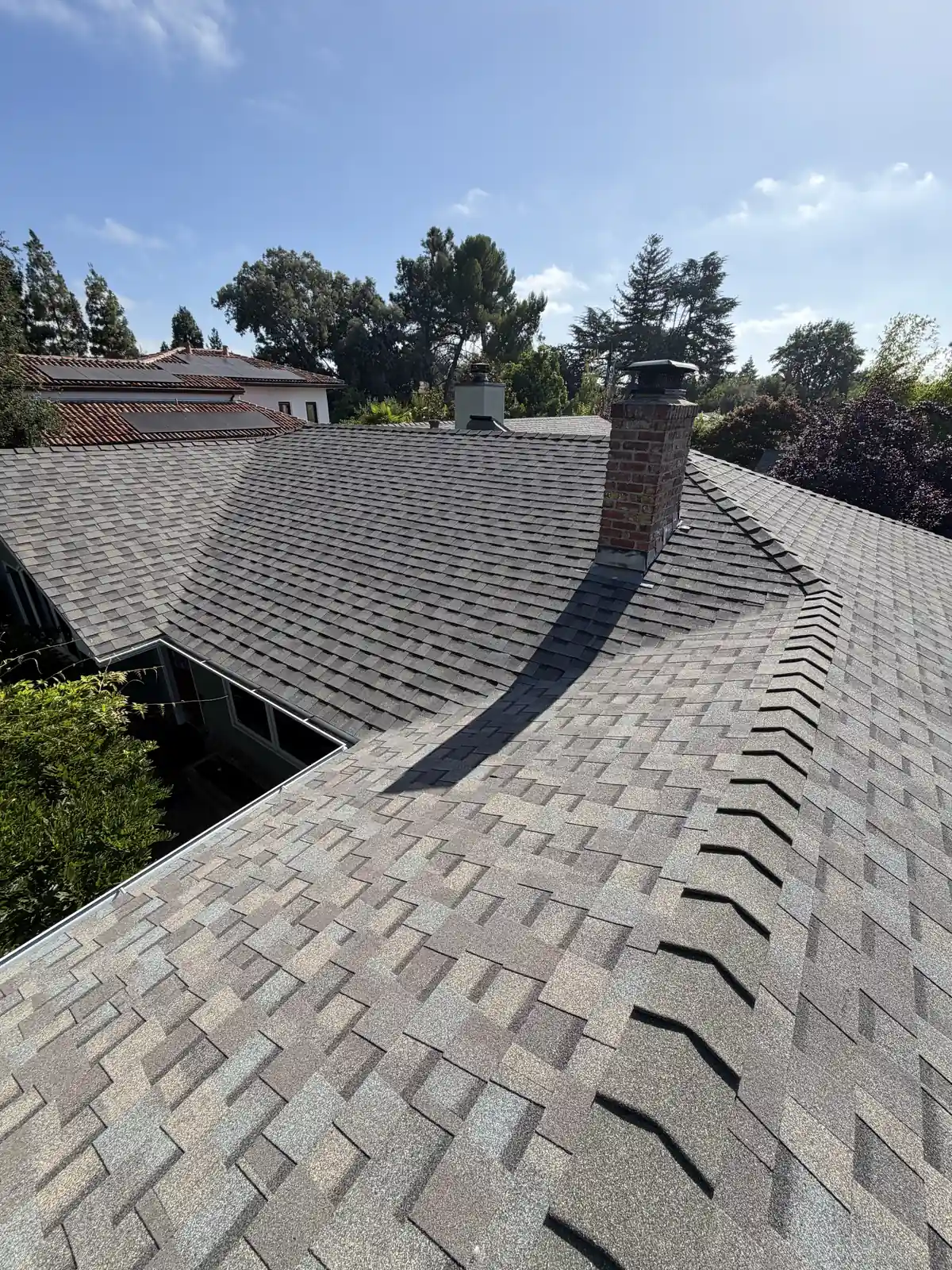
The older houses west of 680 and around Crow Canyon Road are mostly asphalt shingle roofing now, and they raise the questions we know from Fremont's 1960s tracts: how many layers are on the roof, whether the low-slope patio and garage sections have the right material, and whether the attic has enough ventilation. San Ramon's building rules allow a new roof over one existing layer but not over two, so a house on its third roof gets a full tear-off.
A re-roof on one of these houses is the time to fix the things the original builder skipped. We add ridge venting and eave intake, replace rotted fascia and the plywood at the edges where gutters overflowed for years, and install a low-slope membrane on any section too flat for shingles. Our ventilation and insulation page covers why a cooler attic matters in a town with San Ramon's summers.
Stone-Coated Flashings on San Ramon Tile and Shingle Roofs
The pipes and vents on a San Ramon roof are where most leaks begin and where most roofers cut corners. Standard practice is to install galvanized flashings and spray them with paint to approximate the roof color. Under Contra Costa sun the paint begins to fail within the first year, rust follows, and the base of the pipe flashing, where imperfections in the metal and the roofing meet, is exactly where water gets in.
Sonrise finishes every roof with stone-coated flashings from California Stone Coating, Inc., the Fremont manufacturer. The stone coating is a granule finish baked onto the metal, matched to the shingle or custom-blended to the tile, that resists rust and is designed not to chip, peel or fade. Most importantly, it helps waterproof and protect the flashing at the base of the pipe. On a terra cotta tile roof in Gale Ranch the difference is visible from the sidewalk: no gray stubs, no rust streaks down the tile. Read the full story on our stone-coated flashings page.
Permits from the City of San Ramon Building and Safety Services
Re-roofing in San Ramon requires a permit from the City of San Ramon Building and Safety Services, part of the Community Development Department, at the Permit Center at 7000 Bollinger Canyon Road. The city requires a permit whenever more than 200 square feet of roof covering is installed, repaired or replaced, allows a new roof over only a single existing layer, and inspects the work. California's Title 24 energy code applies to re-roofs as well, and cool-roof requirements depend on the Energy Code climate zone assigned to the address, which we confirm before recommending a color. Sonrise pulls the permit through the city's online portal and schedules every inspection.
Sonrise Roofing in San Ramon and the Rest of the Tri-Valley
San Ramon is the northern end of our Tri-Valley coverage. Dublin shares the Dougherty Road corridor with it, Pleasanton is one more exit south on 680, and Livermore is out 580 to the east. Every city we serve, from Oakland down to Mountain View, is listed on our service areas hub.

Testimonials
Real feedback from the East Bay and South Bay homeowners who trusted Sonrise Roofing with their roofs.
Frequently Asked Questions
Yes. Our shop is in Fremont's Centerville district and San Ramon is a straight run up Interstate 680. Adeline does the estimate visit herself and the same crew that roofs Fremont roofs San Ramon.
Usually not, because the original tile goes back on and nothing visible changes. A new tile in a different profile or color, or a switch to shingle, normally needs an architectural application. We prepare the paperwork and the product samples for you.
The city's threshold is 200 square feet of roof covering. Anything larger needs a permit from San Ramon Building and Safety Services, and we handle that as part of the job.
They were painted. Paint on galvanized metal wears off quickly under San Ramon sun and rust follows. Our stone-coated flashings carry a baked-on granule finish that resists rust and matches the roof, and the coating protects the base of the pipe where leaks start.

Talk to Sonrise Roofing About Your San Ramon Roof
Whether the problem is a Windemere tile roof that leaks in the first storm or a west side shingle roof on its last legs, call (510) 791-6457 or write through our contact page. The line is answered 24 hours a day, 7 days a week, the estimate is free, and ask about our workmanship warranty when Adeline is at the house.