
Roofing in Milpitas, CA
Milpitas shares a border with Fremont, and for Sonrise Roofing it is the closest thing to home outside Alameda County.
Milpitas shares a border with Fremont, and for Sonrise Roofing it is the closest thing to home outside Alameda County. The Warm Springs end of Fremont runs straight into the north end of Milpitas on I-880 and I-680, and the crew has been crossing that county line since 1986, usually before the morning traffic builds on the Sunol grade. The whole city is ZIP 95035, but it is really two places: the foothill neighborhoods that climb toward Ed Levin County Park on the east, and the flats around the Great Mall and the BART station on the west.
Milpitas Hills and Flats: Two Roofing Climates in One City
East of I-680, Milpitas rises into the Diablo Range foothills along Calaveras Road and the streets that branch off it toward Ed R. Levin County Park, the county park in the grassland hills above the city. Homes up there sit on sloped lots with big views, take the full afternoon sun on their west and south faces, and catch wind that the valley floor does not. The Calaveras Fault, a long strike-slip fault that runs from the Danville area down through Sunol, Milpitas and San Jose to Hollister, follows those same foothills, and the neighborhoods against the hills sit close to it.
West of I-880, the city is flat, and the roofs are the low-pitched composition shingle of the postwar tracts, plus the tile and shingle of the newer apartment and townhome blocks near the transit center. Between the two freeways is the older core of Milpitas around Main Street and the Civic Center. A hillside house and a flatland house in Milpitas are often the same age, but they do not age the same way, and we look at them differently. The hillside roof needs its windward eaves and valleys checked; the flatland roof needs its gutters and its attic looked at first.
Milpitas Tracts from the 1950s Through the 1970s
Milpitas grew from a small farm town to a real city in one generation, and the housing shows it. Sunnyhills, laid out in 1956 as a union co-op development for the workers at the Ford plant, was the first planned racially integrated community in the country, and its ranch houses on wide lots are still there. Parktown, south of Yosemite Drive, was developed in the 1960s and designed so children could walk to the parks without crossing a main road. The tracts around the schools that opened in 1967 through 1969, Rancho Milpitas, Marshall Pomeroy, Sinnott and Zanker, filled in the 1970s.
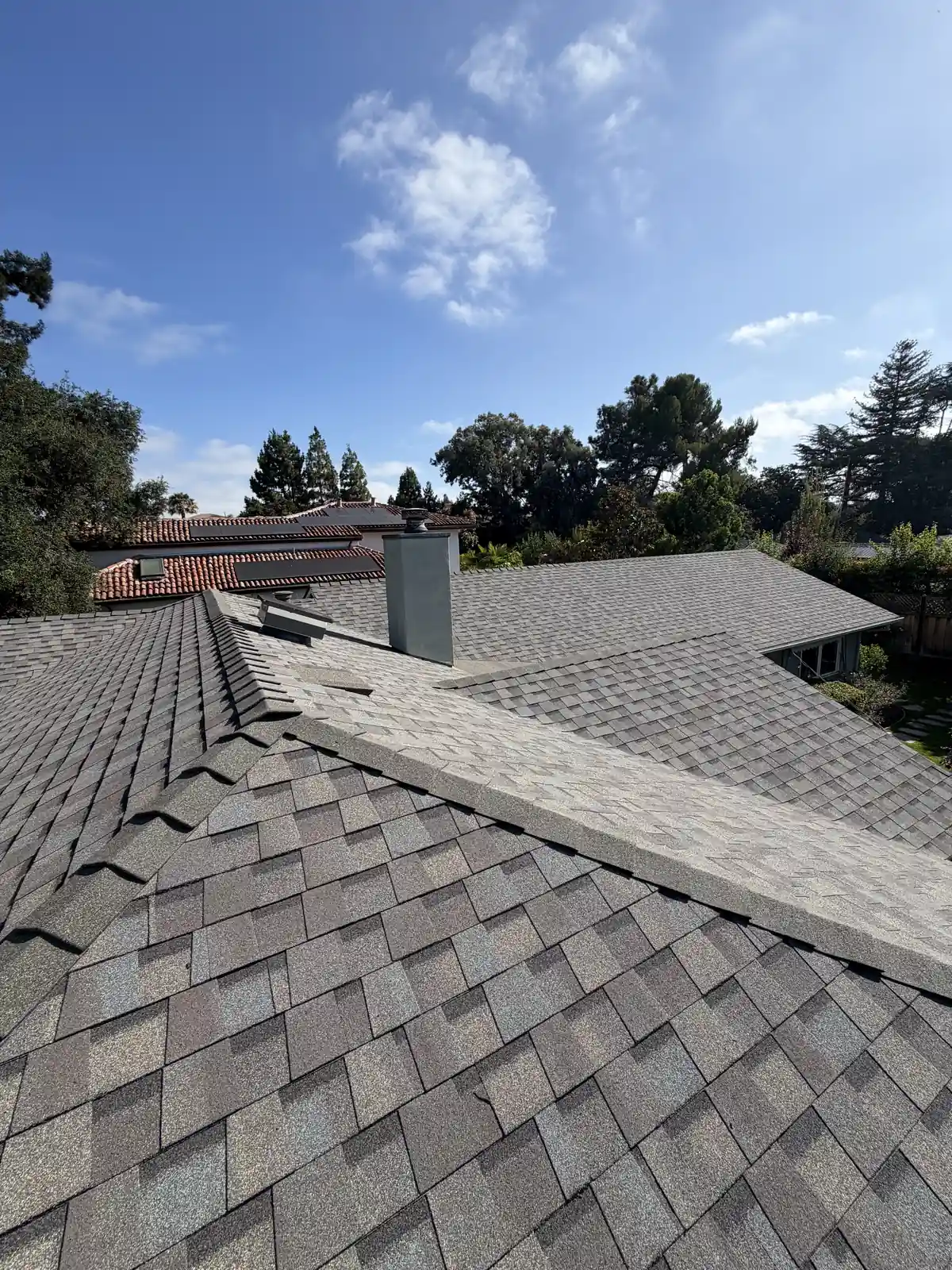
These are the homes we roof most often in Milpitas: single-story ranches from the late 1950s to the 1970s with low pitches, wide eaves, gable-vented attics, a furnace flue and three or four plumbing vents, and, by now, a second or third composition shingle roof. A Parktown roof replacement is a full tear-off to the deck, new underlayment, a new shingle with proper starter and ridge, and stone-coated flashings in place of the painted pipes the last roofer left. Because these attics were never ventilated properly for a zone 4 summer, we correct that at the same time through our ventilation and insulation work, and we get a lot of requests for sun tunnels in the windowless hallways these floor plans are known for.
The Great Mall, the BART Station and Milpitas's Transit Village Roofs
The Great Mall of the Bay Area opened in September 1994 inside the shell of the Ford Motor Company assembly plant that ran from 1955 until its last car in 1983, and it anchors the west side of Milpitas. Around it, the city adopted its Transit Area Specific Plan in 2008 to build housing along the light rail line and the planned BART station. The Milpitas Transit Center and BART station opened in 2020, and the blocks around it are now dense with apartment buildings, condominiums and townhomes built in the last fifteen years, with more planned under the city's Milpitas Metro Specific Plan.
Those roofs are new, but they are also production roofs, and the problems that show up first on a tract-built townhome are the same everywhere: a painted pipe flashing that has faded and begun to rust in its first summer, a valley without metal, a skylight curb that was flashed in a hurry. Homeowner associations manage most of the roofs near the transit center, and our commercial roofing work in Milpitas covers those shared roofs along with the low-slope industrial buildings in the older business parks between the freeways, where ponding water and clogged drains cause most of the leaks.
Hot Summers and Winter Storms on Milpitas Roofs
Milpitas is in California Energy Code climate zone 4, and it is noticeably hotter than Fremont in summer. July highs average in the mid 80s, the foothill neighborhoods run warmer still, and the sun on a south- or west-facing slope in August cooks shingle and bakes the paint off metal. Rainfall is about 15 inches a year and arrives between November and March, and when an atmospheric-river storm comes through, the runoff from the hills above Calaveras Road turns every gutter and valley on a foothill house into a test.
The combination is what wears out a Milpitas roof: heat all summer that dries and curls the shingle, then a winter that finds every crack the heat opened. Our roof maintenance work here is mostly gutter clearing before the rains and moss removal on the shaded north slopes under the oaks, and our roof inspection visits in the fall are timed to catch heat damage before the first storm does.
Stone-Coated Flashings for the Sun on Milpitas South Slopes
Nowhere in our service area is the case for stone-coated flashings clearer than on a south-facing roof in Milpitas. The plumbing vents and flues on that slope take the hottest sun in the city all summer, and the paint that most roofers put on them can begin to wear off within the first year. Once the paint is gone the metal rusts, and the seal at the base of the pipe, which is where metal imperfections and leaks are most likely to show up, is next.
Sonrise Roofing finishes every Milpitas roof with stone-coated flashings from California Stone Coating, the Fremont manufacturer. The stone coating is a long-lasting finish that matches the shingle color, resists rust, and is designed not to chip, peel or fade, which is exactly what a painted flashing does on a Milpitas south slope. It also helps waterproof and protect the flashing at the base of the pipe. The pipe jacks, O'Hagin vents and valleys are all finished to match. Read how it works on the stone-coated flashings page; they go on with every roof we replace in Milpitas.
Repairs and Permits for a Milpitas Roof
Many Milpitas calls are for one leak, not a whole roof. A stain on a ceiling in Sunnyhills, a dripping skylight in a townhome near the transit center, a rotted fascia board behind a gutter that overflowed in January: our roof repair and leak detection visits start with finding the source, and on a ranch roof the source is very often a pipe flashing or a valley rather than the shingle.
Re-roofing in Milpitas requires a building permit from the city's Office of Building Safety, which handles plan review, permits and inspections through the Permit Center on the first floor of City Hall at 455 East Calaveras Boulevard. We apply for the permit and schedule the inspections as part of every job. Milpitas is the first Santa Clara County stop on our service area map: Fremont is next door to the north, and Santa Clara is the next city down I-880.

Testimonials
Real feedback from the East Bay and South Bay homeowners who trusted Sonrise Roofing with their roofs.
Frequently Asked Questions
Next door. Our office is in Fremont's Centerville district, and Milpitas shares Fremont's southern border. A trip to Parktown or the Calaveras Road foothills is a short drive down I-880 or I-680.
They were painted, and the Milpitas sun took the paint off. The metal underneath is rusting, and the base of the pipe is where a shingle roof most often leaks. When the roof is replaced we finish every pipe, vent and exposed valley with stone-coated flashings that match the shingle and resist rust, so there is nothing to repaint later. If the roof still has years left in it, we fix the flashing that is failing and leave the rest alone rather than selling you a roof you do not need yet.
Yes. We work with homeowner associations on shared roofs in the transit area and with individual owners on the newer single-family homes nearby.
Yes. The city's Office of Building Safety issues re-roof permits through the Permit Center at City Hall, and we take care of the application and inspections.
We recommend against it. A tear-off lets us inspect the deck, replace rotted wood, run new underlayment and install proper flashings. A third layer hides problems and adds weight the roof was not built to carry.

Call Sonrise Roofing for Your Milpitas Roof
The office answers (510) 791-6457 around the clock, and the contact page form works too. Adeline will cross the county line from Fremont, get on the roof, and write a free estimate for a Milpitas roof built for the heat and finished with stone-coated flashings.