
What Drives the Cost of a Roof Replacement in Fremont and the East Bay
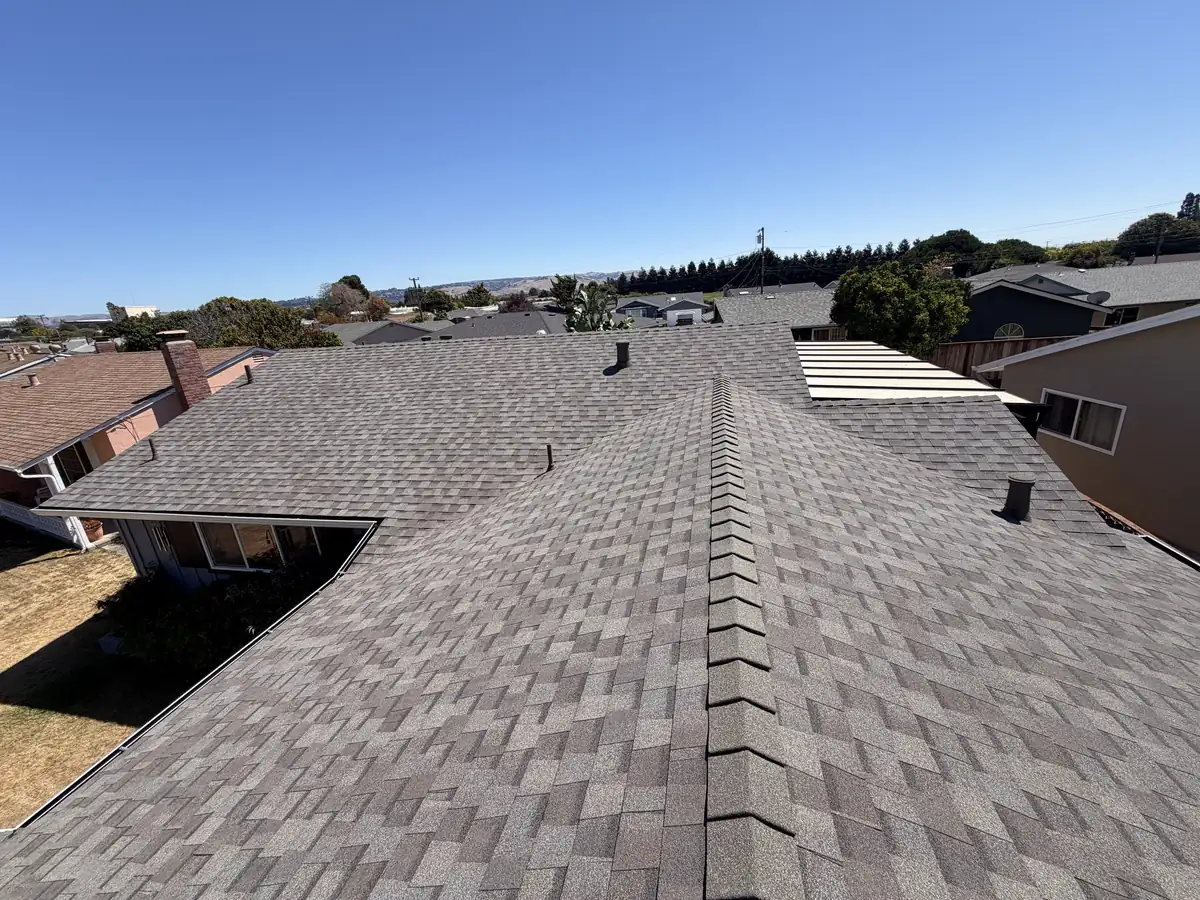
The first question on almost every call to our office is some version of "what does a new roof cost." The honest answer is that Adeline cannot tell you until she has stood on it, and anyone who quotes a number over the phone is guessing. What we can do is explain what she is looking at when she writes an estimate, because once you know the drivers you can read any roofer's proposal, ours included, and see where the money goes. This post does not put dollar figures on anything. It tells you what moves the figure up or down.
Roof size and pitch
Roofers measure in squares, and one square is one hundred square feet of roof surface. A bigger roof takes more shingles, more underlayment, more nails and more labor, so size is the base of every estimate. Pitch multiplies it. A low, walkable roof on a 1960s ranch house in Fremont's Centerville or Irvington districts goes quickly. A steep roof needs roof jacks, planks and harness lines, the crew moves slower, and the material has to be carried up and staged rather than dropped in bundles. The same number of squares on a steep roof is a longer job than on a flat one.
Complexity counts alongside pitch. Every hip, valley, dormer, skylight and pipe is a place where shingles are cut, flashing is fitted and the work slows down. A plain gable with two slopes and three pipes is the cheapest shape a roof can be. A roof with four valleys, two chimneys and a dozen penetrations is a different job on the same house.
Layers to tear off
California allows a second layer of shingles over the first in some cases, and plenty of East Bay houses are carrying one. Some older houses are carrying composition shingle over the original wood shake. Every layer has to come off before a new roof goes on, and every layer adds labor, adds weight to the dumpster and adds time. If you do not know how many layers are on your roof, Adeline will find out at the estimate, usually by looking at the edge of the roof at the eave or at the attic side of the decking.
Decking repair
Under the shingles is the deck, and on a house built before the 1980s that deck is often skip sheathing, boards spaced a few inches apart that were laid to hold wood shake. A shingle roof needs solid plywood or oriented strand board over that, so a house going from its original shake decking to a modern roof has a sheathing line on the estimate. On roofs that already have plywood, the cost is in the repairs: sheets that are soft from an old leak, delaminated at the eave, or rotted around a chimney. Nobody can see all of it until the old roof is off, so a good estimate lists a per-sheet allowance and tells you what happens if more is found. A proposal that does not mention decking at all is a proposal that has not thought about it.
Material grade
Asphalt shingles come in a range of grades. A basic three-tab shingle is the least expensive. An architectural or dimensional shingle is thicker, heavier and carries a longer manufacturer rating. Beyond that are heavier designer shingles and impact-rated products. Underlayment ranges from felt to synthetic to self-adhering membrane in the valleys and at the eaves. Ridge caps, starter strips and hip and ridge vents each have a grade too. Two roofers quoting "architectural shingles" can be quoting products with very different lifespans, so ask for the product name and the line on the estimate that lists the underlayment. Our asphalt shingle roofing page walks through what we install and why.
Tile and metal roofs sit in a different range altogether, and a tile roof adds a structural question, because the framing has to carry the weight. We repair and replace both, but on a typical East Bay house the material conversation is about which shingle.
Cool-roof requirements
California's Energy Code, Title 24, Part 6, sets cool-roof requirements for some re-roofs based on the climate zone the house sits in and the slope of the roof. Fremont is in climate zone 3, where a typical steep-slope shingle re-roof has no prescriptive cool-roof requirement. Livermore, Dublin, Pleasanton and San Ramon are in zone 12, and Sunnyvale, Santa Clara, Milpitas and Mountain View are in zone 4, where the requirement does apply to a re-roof unless an exception is met. A cool-rated shingle can cost more than a standard one in the same line, and it narrows the color choices, so where you live is a cost driver. We wrote a separate post on cool roofs and Title 24 that goes through the zones and the numbers, and we check the current Energy Code on every job, because the rules change with each code cycle.
City permits
Every city we work in issues its own building permit for a re-roof. In Fremont that is the Building and Safety Division; in Hayward, Oakland, Livermore and the rest it is that city's building department. The permit line on an estimate covers the application, the inspection visits and the energy-code paperwork that goes with them. A roofer who offers to skip the permit is offering to skip the inspection, and a roof with no permit history becomes a problem the day you sell the house. We pull the permit on every replacement.
Access and disposal
Where can the truck park, where can the dumpster sit, and how far is it from there to the roof? A house on a wide Fremont street with a driveway is easy. A house on a narrow Oakland hillside lot, or a rear unit with no driveway, means carrying material through a side yard and hauling debris the same way, and that shows up in labor. Disposal is a line of its own. Tear-off debris is heavy, landfill charges are by weight, and a two-layer roof fills a bigger dumpster than a one-layer roof.
Gutters and flashings done at the same time
This is the section most estimates skip, and it is the one Adeline cares about most. When the old roof is off, the flashings are exposed: the pipe flashings, the vent flashings, the step flashing along walls, the counterflashing at the chimney, the valley metal and the drip edge. Replacing them while the roof is open is the cheapest it will ever be. Reusing a rusted pipe jack under new shingles saves a little money on the day and puts a leak into a brand-new roof.
We finish every pipe, vent and valley with a stone-coated flashing as part of the job, so the line is on our estimate by default. Gutters are the same logic. If the gutters are sagging, rusted or undersized, replacing them while the fascia is exposed and the crew is already there is simpler than coming back. Our gutters and downspouts page covers what to look for.
How to compare estimates line by line
Get at least two written estimates and lay them side by side. Check that each one names the shingle product and grade, the underlayment, the ice-and-water membrane and where it goes, the starter and ridge products, the ventilation, the flashings and whether they are new, the decking allowance and the per-sheet price for more, the number of layers being removed, the permit, the disposal, the gutters if any, and the cleanup. Then check what is missing. A lower total is usually a shorter list, not a better price on the same list.
Ask each roofer who is actually on the roof, whether the flashings are new or reused, and what happens if the decking is worse than expected. Ask about the workmanship warranty and get the answer in writing. Then ask for the California contractor license number and look it up on the state's contractor license lookup before you sign anything.
Why the cheapest bid often skips the flashing
New shingles cover everything, including the shortcuts. A crew that reuses the old pipe jacks, tucks new shingles over the old step flashing, and reuses the old valley metal can bring a bid down and the roof will look perfect on the day they leave. The leaks come back two or three winters later, at the exact spots the old flashings were left in place, and by then the bid that won on price has cost more than the bid that lost. The flashings are the roof's joints. Ask about every one of them.
Keep Reading
Why Painted Roof Pipes Fail in the Bay Area explains the flashing problem in detail.
For the work, see roof replacement and roof inspections. If you are out in the Tri-Valley, the Livermore roofing page covers the climate zone 12 cool-roof question for that side of the hills.
Get a written estimate from someone who has stood on the roof
Call Sonrise Roofing at (510) 791-6457 or reach us through the contact page. Estimates are free, Adeline writes them herself after looking at the roof and the attic, and every line is explained. Our roof replacement page covers the full process.