
Why Painted Roof Pipes Fail in the Bay Area (and What We Do Instead)
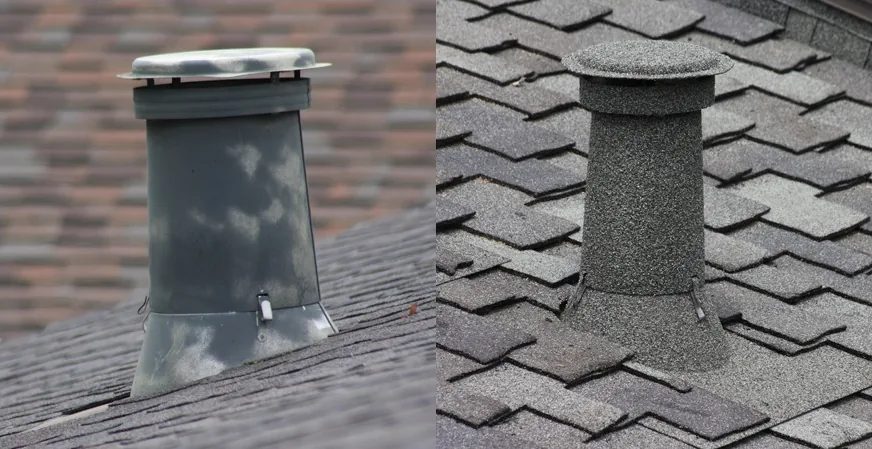
Stand in the street in any neighborhood, in any town, and look up at the roofs. On most of them you will see a handful of metal pipes and vents poking through the shingles, and on most of those the paint is already going. Some are chalky, some are streaked with rust, and some have a bare silver collar at the bottom where the paint has let go completely. That collar is the part of the story that matters, because the base of the pipe is where the roof leaks. This post explains what you are looking at, why it happens so fast in our climate, and why Sonrise Roofing finishes every pipe with a stone-coated flashing instead of a coat of paint.
What a painted pipe jack looks like after one year
A pipe jack, or pipe flashing, is the metal skirt that seals a plumbing vent or furnace flue where it comes through the roof. Most are galvanized steel. On a new roof the crew slides the flashing over the pipe, nails the base under the shingles, and sprays the whole thing with a can of paint chosen to roughly match the shingle color. On the day the roof is finished it looks tidy.
Give it one East Bay winter and one East Bay summer. Winter rain from November into March sits on the flat base of the flashing and runs down the pipe every time it storms. Then the dry season arrives, and from June through September the roof surface bakes in the afternoon sun. The paint dulls first. Then it chalks, so that a fingertip comes away white. Then it lifts in flakes along the top of the pipe and around the base, where the metal moves the most. Adeline's family has been roofing Fremont since 1986, and her rule is simple: a painted pipe starts to show it within the first year. By the third or fourth year it looks like something nobody bothered to finish.
Why the paint lets go
Paint is a thin film sitting on a smooth, slick metal surface, and the roof is one of the hardest places on a house to hold a film like that. Three things work against it.
Heat cycling. A dark shingle roof gets far hotter than the air on a summer afternoon and cools quickly after sunset. The steel pipe and its flashing expand and contract with every cycle, and the paint does not move at the same rate. Over hundreds of cycles it cracks at the tightest bends, which are the top of the flashing collar and the joint where the collar meets the base.
Sun. Ultraviolet light breaks down the binder in ordinary spray paint. That is the chalking you can wipe off with a finger, and once the binder is gone the pigment has nothing holding it to the metal.
Water. Rain runs down the pipe and pools where the collar meets the flat base plate. Once there is a hairline crack in the paint, water gets behind the film and lifts it. Galvanized steel resists rust on its own for a while, but the zinc layer is thin, and every scratch from a ladder, a tree limb or a roofer's boot is a place for rust to start under the paint.
Painting was never meant to be a weatherproof finish. It was a way to make the flashing less ugly for a few seasons.
Why the base of the pipe is where the leak starts
Here is the part most homeowners never hear. A pipe flashing has two jobs. The collar keeps rain from running straight down the pipe. The base plate keeps water that reaches the roof surface flowing over the shingles below it instead of under them. The weak point is the joint between the two, where the metal has been formed, soldered or crimped at the factory, and where any imperfection in the metal sits.
That joint is also where the water is. Every drop that runs down the pipe lands on it, and every drop that blows across the roof piles against the uphill side of it. Once the paint fails there, rust follows, and rust on a formed seam opens a path. On the Fremont and Newark roofs we repair, a stained ceiling under a bathroom is very often a pipe flashing whose base has rusted through, not a shingle problem at all. We cover what that inspection looks like on our roof leak repair and detection page.
What a stone-coated flashing does differently
The stone-coated flashings we install are made by California Stone Coating, Inc., a Bay Area manufacturer, and the reason Adeline is so firm about them is that they solve the exact problem described above. Instead of a film of paint, the flashing is finished with a fused coating of stone granules, the same idea as the granule surface on the shingle itself.
That changes several things at once. The finish matches the shingle color, and the manufacturer can blend a custom color for a roof that is not a standard shade. It is designed not to chip, peel or fade the way paint does, so the roof looks finished in year ten the way it did on day one, with no repainting. The coating resists rust, rot, algae and fire. Most important, it helps waterproof and protect the flashing at the base of the pipe, which is exactly where the metal imperfections sit and where leaks are most likely to begin. The coating runs up the collar as well, so there is no silver stub sticking up out of a brown roof.
None of that makes a roof leak-free forever, and we will not tell you it does. It takes the single most common leak point on a shingle roof and gives it a finish that lasts as long as the shingles around it. The full story, with the manufacturer's details and the vents and valleys we finish the same way, is on our stone-coated flashings page.
How to check your own roof from the ground
You do not need to climb a ladder to know whether your pipes are in trouble. Pick a bright morning, stand across the street, and look at each slope with a pair of binoculars if you have them.
Look for color. A pipe that is a different shade from the shingles, or shows silver at the base, has lost its paint. Look for streaks. Rust running down the shingles below a pipe means the flashing itself is corroding. Look for a raised or cracked collar at the top of the flashing, which is the rubber or metal seal working loose. Look at the uphill edge of the base plate for lifted shingles or debris packed against it. And look inside: a faint ring on the ceiling of a bathroom, laundry room or kitchen usually sits within a few feet of a vent pipe above it.
If you see any of that, call before the rain does the checking for you. If you see nothing but want a set of eyes on it, a roof inspection covers every penetration on the roof, not just the pipes.
What we do on a repair and on a re-roof
On a repair, we pull the failed flashing, put a sound new one in its place and reseal the shingles around it. It is a small job, and it is one of the highest-value repairs on a roof because of how often that spot is the whole problem. The stone-coated finish is a different matter: those flashings are woven in under the shingle courses as a roof is laid, so they go on with a full roof replacement, never as an add-on to a roof that is already down. On a replacement, in Union City, Hayward or anywhere else we work, every pipe, vent and valley is finished stone-coated as part of the job, not as an upgrade you have to ask for. That is the standard, and it has been from the day Adeline took the company over.
Frequently Asked Questions
You can, and it will look better for a season. It will not fix a rusted base or a cracked collar, and the new paint will fail the same way the old paint did. If the base is already rusted, the flashing needs to come out, and paint will not buy you much time before it does.
Yes. The flashing plates and valley metal have to be woven in under the shingle courses while the roof is being laid, so they go on with a full roof replacement. On an older roof the surrounding shingles are too brittle to lift and re-lay without damaging the field, which is why we do not add them after the fact. If your roof still has years in it, we will say so and repair only what needs repairing.
Trace it. A stain near a bathroom, kitchen or laundry room, or under the furnace flue, is very often a pipe flashing. The only way to be sure is to look at the roof above it and in the attic below it, which is what a leak detection visit does.
California Stone Coating, Inc., a Bay Area manufacturer that specializes in this finish. Adeline has worked with their products for years and puts them on every roof Sonrise builds. You can read about the line at californiastonecoating.com.
Keep Reading
The Bay Area Rainy Season Roof Checklist walks through pipe bases, valleys and the other spots to check before November.
For the work itself, see stone-coated flashings and roof repair. If you are in our home city, the Fremont roofing page covers the neighborhoods we grew up working in.
Look up, then call
If the pipes on your roof look like the ones in this post, call Sonrise Roofing at (510) 791-6457 or send a note through the contact page. The office line is answered 24 hours a day, 7 days a week, estimates are free, and Adeline comes out herself.